Skip to content
Toledo Foundation

Serving Toledo and nearby areas

Cracks in Brick Walls in Toledo, OH

Cracks in the brick outside your home can mean worn mortar or a foundation that moved, and a free inspection tells you which one before you pay for a fix.

Book a free foundation inspection

Tell us what you are seeing. A local specialist calls you back the same business day.

Local to Toledo

We connect property owners in Toledo and nearby areas, including Old West End, Point Place, Sylvania, Ottawa Hills, Maumee and Perrysburg, with one independent local foundation repair specialist.

  • Hard winters on mortar

    Lucas County sets the frost line at 36 inches and lists an air freezing index of 1,500 degree days. Water that soaks into mortar freezes and breaks it down.

  • Old walls

    About 31 percent of Toledo homes were built before 1940, so a lot of brick and mortar here is more than 80 years old.

  • Historic district rules

    In the Old West End historic district, exterior work needs a Certificate of Appropriateness before it begins.

What it costs

Typical published ranges for Toledo. The contractor's written estimate is the price, and the inspection is free.

WorkTypical range
Inspection and written estimate Free
Tuckpointing, walls up to 8 feet $5 to $10per square foot
Tuckpointing, walls over 8 feet $10 to $25per square foot
Typical tuckpointing project $1,500 to $2,500
Pier, if a corner has settled $1,000 to $3,000each

See typical foundation repair prices in Toledo

What you will notice

Brick cracks can be small and slow, so they are easy to walk past. These are the ones to look for on a walk around the house:

Zigzag cracks

That step down through the mortar from a corner or a window.

Cracks wider at the top

Than at the bottom, often near one corner of the house.

Cracks over windows and doors

Running up from the corners of the opening.

Sandy, crumbling mortar

That you can scrape out with a key.

Loose or missing bricks

Often near the ground, under windows, or at the chimney.

A chimney that leans

Or leaves a gap where it meets the house.

Bricks that flake or pop

Their faces, called spalling.

Cracks that match the basement

A crack outside that lines up with one inside the basement.

Two very different causes

Brick cracks come from one of two places. The fix for each is different, so it is worth knowing which you have.

Worn-out mortar. Mortar is meant to be the soft, weak part of a brick wall. Over decades, water soaks in, freezes, and breaks it down. Lucas County puts the frost line at 36 inches and counts a lot of freezing each winter. Census data shows about 31 percent of Toledo homes were built before 1940. Mortar that old has been through many hard winters. When it wears out, you see sandy joints, small cracks everywhere, and loose bricks. The foundation may be fine.

Foundation movement. If the ground under one part of the house moves, the brick above it cracks in a pattern. Most of Toledo sits on old lake-bed clay that USDA calls very poorly drained, with a water table near the surface from November to May. Wet soil and freezing can push on basement walls or let a corner sink. When that happens, the brick above shows a clear zigzag, wider at one end, often lined up with a crack in the basement wall below.

There is a third, smaller cause. The steel pieces that hold brick over windows and doors can rust. Rust swells and pushes the brick up, which cracks the corners of the opening.

Cosmetic or urgent?

Usually not urgent:

  • Thin cracks in the mortar with no pattern
  • Sandy joints across a whole wall, with no bulge or lean
  • A few hairline cracks that have not changed in years

These still need repointing in time, because worn joints let in water.

Get it checked soon:

  1. A zigzag crack wider than about a quarter inch
  2. A crack that is wider at the top, near a corner
  3. Cracks outside that match cracks in the basement
  4. A chimney that is leaning or pulling away
  5. Brick that bulges out from the wall
  6. Doors or windows nearby that started to stick

How it is usually fixed

The contractor we connect you with will look at the basement and the outside together to find the cause first.

Tuckpointing

Old mortar is ground out and new mortar packed in. This is the fix when the mortar is worn and the foundation is fine.

Brick replacement

Broken or flaking bricks are cut out and new ones set in, matched as close as possible.

Lintel repair

Rusted steel over a window is cleaned or replaced, and the brick above is reset.

Foundation repair first

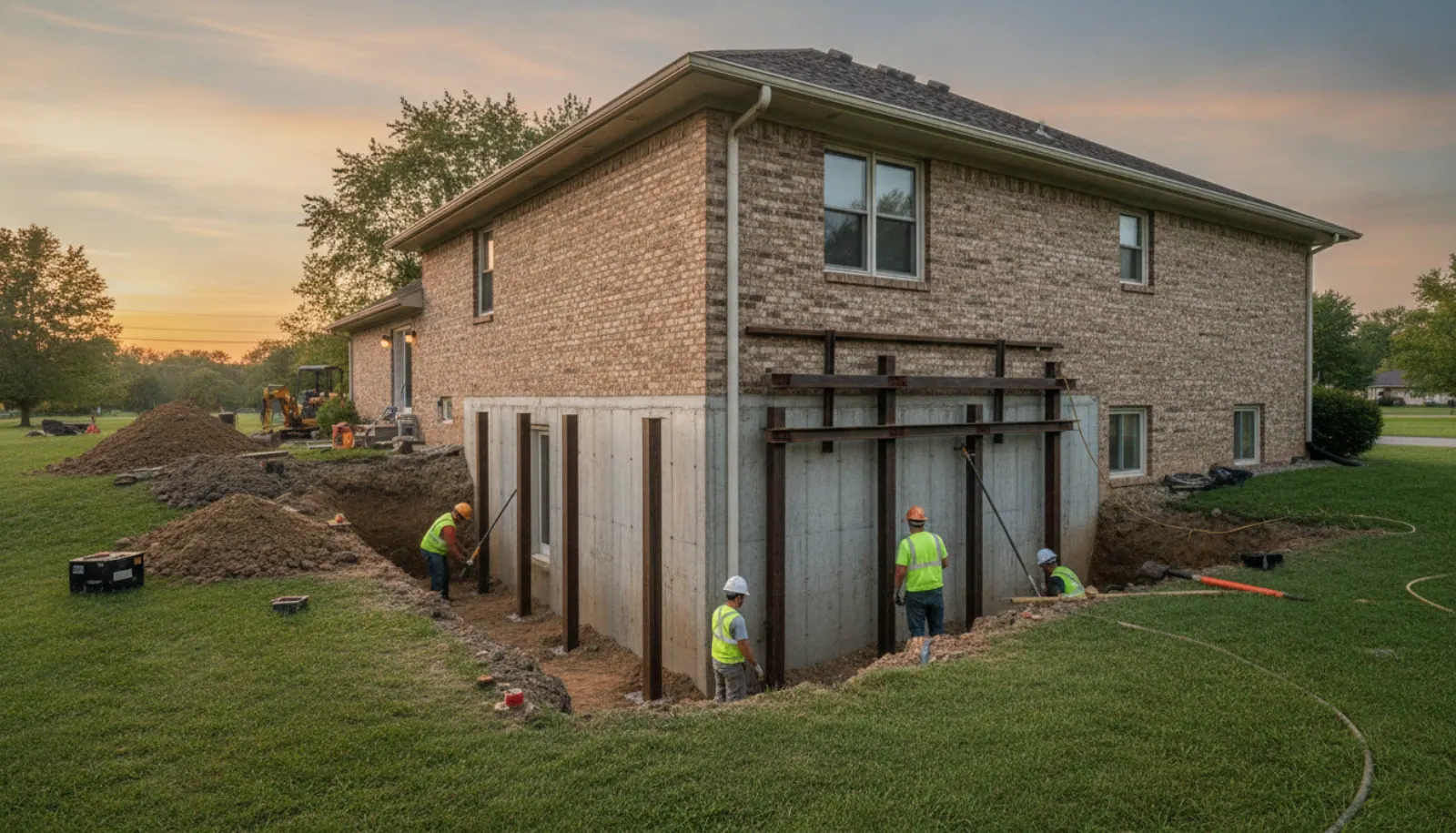
If a corner settled or a basement wall moved, that gets fixed first, often with piers or wall anchors. Patching brick on a moving foundation means it cracks again.

Older brick is often softer than new brick. A good mason picks a mortar that is softer than the brick, so the joint takes the wear instead of the brick. Ask about it.

If your home is in the Old West End historic district, exterior work needs a Certificate of Appropriateness before it starts. The district follows written design guidelines. Plan for this step in your timeline.

What it costs

The table shows typical ranges from published cost guides. They are not quotes. Tall walls cost more because of scaffolding. If the cracks come from the foundation, that repair is priced on its own. Your written estimate is the real number.

What to do before the inspection

Walk all four sides

And take photos of each crack with a coin for size.

Mark crack ends

With tape or chalk and the date.

Check the basement

Under each crack for a matching one.

Note the chimney

Look for a lean or a gap at the roof line or the wall.

Find out if you are in a historic district

If you live in or near the Old West End.

Frequently asked questions

Is a crack in my brick a foundation problem?

Sometimes. Cracks that zigzag down from a corner, get wider at the top, or line up with cracks in the basement often point to the foundation. Crumbly, sandy mortar all over the wall with no pattern usually points to old mortar that needs repointing.

Do I need permission to repair brick in the Old West End?

Homes inside the Old West End historic district need a Certificate of Appropriateness before exterior work starts, even when no building permit is needed. Check whether your address is inside the district, and ask your contractor to plan for the review.

What is the difference between tuckpointing and repointing?

Both mean grinding out old, worn mortar and packing in new mortar. People in the trade use the two words in slightly different ways, but for most homeowners they mean the same job.

Can the wrong mortar damage old brick?

It can. Older brick is often softer than modern brick. Mortar that is much harder than the brick can make the brick crack or flake instead of the joint. Ask what mortar will be used and why.

Why is my chimney pulling away from the house?

A chimney is heavy and sits on its own footing. If that footing settles, or the mortar fails from years of water and freezing, the chimney can lean or leave a gap. A gap that grows should be checked soon.

Find out what is cracking your brick

A free inspection tells you whether it is the mortar or the foundation, and what each would cost. Call (419) 670-7969 or send the short form, and a local crew will call you back, usually the same day. The price comes in writing, and the choice is yours.

(419) 670-7969 Free inspection